
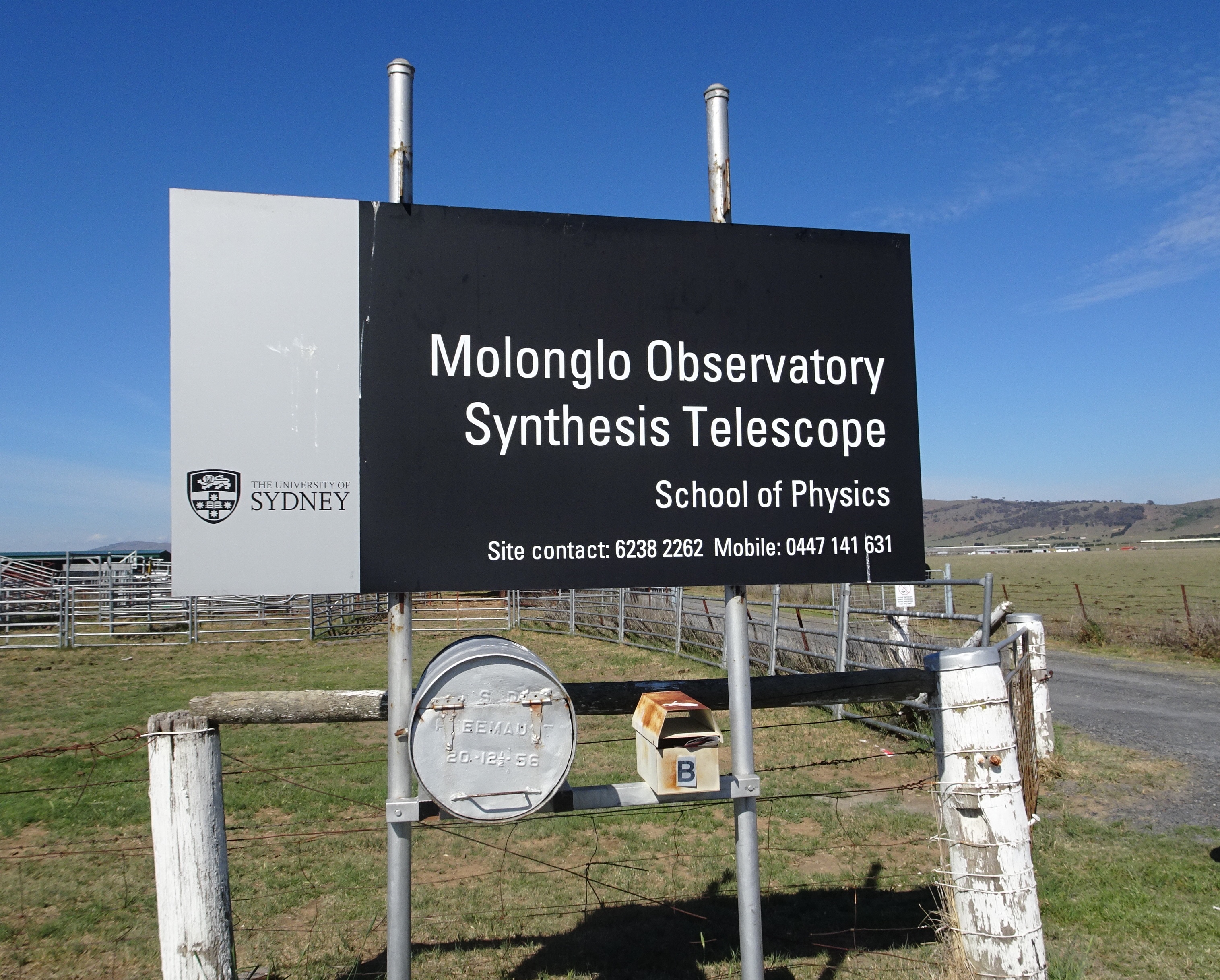
Location: Hoskintown, NSW, 2621
Country: Ngarigo (Ngarigu)
LGA: Queanbeyan-Palerang Regional Council
Region: Southern Tablelands
Website: en.wikipedia.org/wiki/Molonglo_Observatory_Synthesis_Telescope
Map: below
The University of Sydney’s Molonglo Observatory Synthesis Telescope (MOST) near the village of Hoskinstown, is a parabolic cylindrical antenna consisting of 88 bays each with four identical modules, giving it a total of 352 independent antennae.
This instrument has been used for many pioneering studies, including the Sydney University Molonglo Sky Survey, the detection of Fast Radio Bursts and research on pulsars.
An Iconic Australian Telescope, Upgraded for Future Science, Rami Mandow, Space Australia, 11 March 2022.
Australia’s deep history in radio astronomy dates back decades, to a time when the second great war had ended and radar technology had emerged as a gateway into studying the heavens. One Australian radio telescope, in particular, has its roots grounded firmly in these early days of pioneering work in radiophysics, with a story punctuated with discovery, triumph and debate.
It is the story of the Molonglo Observatory.
Located just outside the city of Canberra, the observatory is not as typical in appearance as other familiar radio telescopes, such as the CSIRO Parkes and ASKAP instruments. There is no parabolic dish antenna that steers in different directions, nor an array of dipole-like structures that resemble the spider-like Murchison Widefield Array telescope. In fact, when people first come across it, they often mistake it for a giant irrigator. As it is big. Really big. Over one and a half kilometres in length.
If you could get an aerial view of the Molonglo observatory, you might notice it is shaped like a giant plus symbol, or cross featuring a north-south (N-S) and east-west (E-W) arm. In fact, you could spot the large structure, with Google Earth today.
B.Y. Mills, Origins of the Molongolo Radio Observatory: the Cross and the MOST, Australian Journal of Physics, 1991, 44, 719-27

Caption: Univeresity of Canberra Heritage students on an excursion to the Molonglo Radio Telescope i 2018. Photo by Merrill Findlay.
2017: The first interferometric detections of fast radio bursts, in Monthly Notices of the Royal Astronomical Society, Volume 468, Issue 3, July 2017, Pages 3746–3756
2015, 3 December, Astronomers use redeveloped telescope near Canberra to investigate mysterious phenomena, by James Fettes, ABC News
Scientists and stargazers will search for secrets of the distant universe with the launch of a redeveloped radio telescope east of Canberra.
The Molonglo Observatory Synthesis Telescope, or MOST, has undergone a major revamp in partnership with the University of Sydney and Swinburne University.
The director of Swinburne’s Centre for Astrophysics and Supercomputing, Professor Matthew Bailes, said a cluster of signal-processing computers would boost the telescope’s capacity.
“We have to do 250 trillion calculations a second to process the data that’s coming off the telescope,” he said.
In the course of a year the telescope will process almost an exabyte of data, or one billion gigabytes.
2015, 5 December, University of Sydney celebrates 50 years of Molonglo
On its 50th anniversary, the Molonglo Observatory Synthesis Telescope will undergo major upgrades to deliver new capabilities for astronomers
Since its inception in 1965, the Molonglo Observatory Synthesis Telescope has been owned and operated by the University of Sydney. Originally built as the Molonglo Cross, the telescope has two huge cylindrical arms that stretch across the Molonglo valley, east of Canberra.
The University of Sydney is now ushering in a new era for the Molonglo Observatory Synthesis Telescope (MOST), announcing major upgrades to the instrument. From 2015, 50 years since the telescope started work, it will commence regular science observations as part of the UTMOST project in collaboration with Swinburne University, funded primarily by the Australian Government.
Facilitated by the Australian Research Council Centre of Excellence for All-Sky Astrophysics (CAASTRO), the University of Sydney, Swinburne Universityand CSIRO have formed an historic partnership to carry out the million dollar update of MOST.
While the structure of the telescope will be unchanged, a new supercomputer backend will allow astronomers to handle up to 22 gigabytes of data per second. This is entering the domain of big data, with smart electronics and clever software programs to process data in real time. Having directed the Molonglo telescope for more than a decade, Professor Anne Green from the School of Physics said the upgrade would be game-changing.
“The major redevelopments to the Molonglo Telescope will deliver new and exciting capabilities,” Professor Green said.
“For almost a decade, fast radio bursts (cosmic radio signals that last just a few milliseconds) have mystified astronomers. With the upgrade to Molonglo, we will have the opportunity to hunt for the mysterious bursts. We don’t know where they are or what they are, but with this new capability we have an excellent opportunity to answer these questions.”


Captions: Photos from an excursion to Molonglo Telescope by Heritage students from University of Canberra, led by Dr Alison Wain in 2018.
2018: Alison Wain, The Molonglo Radio Telescope – a science, heritage and education partnership, Proceedings of the Australia ICOMOS Science Heritage Symposium, Hobart, 2018.
The Molonglo Radio Telescope near Hoskinstown in New South Wales is both heritage and a working research instrument. A large cross-shaped array designed by prominent Australian radio astronomer Bernard Mills, the telescope has been a test bed for new technology and ground-breaking science for over 50 years and is currently being used to study Fast Radio Bursts. The advent of remote data acquisition, however, has reduced the number of people visiting and forming personal connections with the instrument, leading to perceptions that it is ageing and unfashionable, and making it vulnerable to decommissioning and disposal. To make this significant piece of heritage sustainable it is necessary to ensure that more people are aware of it and feel that they value it and are connected to it. This should not be limited to scientists, but should include the general public and especially the local communities, for whom it can be a source of inspiration and opportunity.
This paper looks at a project undertaken to explore ways to generate public interaction with the telescope, drawing not just on its astronomical significance but on the stories of social, political and technological changes reflected in its history; embodied experiences of the site; interest in the mechanical design; interest in the on-site animal communities; and creative responses to site experiences. These activities allow people to find bridging values to connect their existing lives and interests with the sometimes unfamiliar world of professional science.See the full conference proceedings for more >>
2020: Adam Deller and Chris Flynn, Vintage telescope rebooted in the hunt for FRBs. Nature Astronomy 4, 292 , March 2020
A cost-efficient overhaul of the 50-year-old Molonglo radio telescope will equip it as a standalone fast radio burst detector and localizer, explain Adam Deller and Chris Flynn.
Every minute or so, somewhere in the Universe, a cosmic radio generator flips on with the power of a billion Suns, only to flip off again a hundred times faster than you can blink. These millisecond-duration fast radio bursts (FRBs) bombard the Earth day in and day out from every direction, but we do not know what could birth such short-lived and violent phenomena. Pinpointing their origin with radio telescope arrays requires capabilities that strain the limits of computational resources, but the venerable Molonglo radio telescope near Canberra, Australia, is a surprisingly good match to the requirements.
Spotting a fleeting FRB signal is a huge challenge, as they are smeared almost beyond recognition by their passage through the intervening interstellar and intergalactic plasma. An FRB-finding system must perform an enormous number of computational trials, searching over a range of arrival times and frequency-dependent delays in order to reconstruct a detectable pulse. Adding the requirement for high angular resolution in order to pin an FRB to its host galaxy causes the brute-force computational challenge to explode: for every square degree of the sky to be searched, millions of megapixel images must be processed every second. In order to reach a field of view spanning many square degrees, computational shortcuts are essential.
The Molonglo Observatory Synthesis Telescope (MOST) is perfectly laid out as an efficient FRB finder and localizer. This 53-year-old facility (Fig. 1) is operated by the University of Sydney and consists of two perpendicularly oriented cylindrical reflectors, each arm of length 1.6 km. With the largest collecting area (36,000 m2) of any telescope in the Southern Hemisphere, it is ideal for detecting faint signals.
In 2016, the east–west arm of this ‘cross’ telescope received an early 50th birthday present: new receivers and an FRB-finding digital signal processing system1 and becoming UTMOST. …
To unlock the full potential of this vintage telescope, the UTMOST-2D project is now underway. By deploying new feeds and receivers on the long-dormant north–south arm of the cross (last used in the 1970s!), the Molonglo telescope will once again be able to snap usable instantaneous images of the radio sky. …. As the number of telescope segments (termed modules) on the north–south arm is initially small, this large efficiency gain sacrifices very little sensitivity. … The UTMOST-2D localization system will come online during 2020.
Despite using cost-saving commodity components borrowed from fields such as mobile telephony, the UTMOST-2D system has outstanding performance — calibrator observations show that each new module is ten times more sensitive than an east–west arm equivalent. With a continued deployment of new modules beyond 10% of the arm, the role of the arms could flip, with the more sensitive north–south arm functioning as primary FRB detector. A fully populated north–south arm would resemble the Canadian Hydrogen Intensity Mapping Experiment (CHIME) telescope but with sharper angular resolution; it would be capable of detecting an FRB and monitoring 1,000 radio pulsars per day. As a bonus, the total absence of moving parts in the north–south arm would greatly reduce maintenance costs.
2022: Swinburne University: Upgraded UTMOST finds its first Fast Radio Bursts
UTMOST: The Transient Universe in Real Time, Swinburne University of Technology, Melbourne, Dec 2, 2022
UTMOST-NS has reached a major milestone, having just made its 25,000th pulsar timing measurement.
We have been timing pulsars in a new Southern Hemisphere program which kicked off at the Molonglo Radio Telescope in April 2021.
Many pulsars are observed daily, as they are in isolated regions of the sky. Other pulsars share the busy sky in the Milky Way, and are timed once a week.
We are timing just over 170 pulsars and magnetars and averaging around 70 pulsar measurements per day, so that the typical pulsar gets observed every few days.
The UTMOST team (Matthew Bailes, Marcus Lower and Chris Flynn) have been working with Liam Dunn, George Howitt, Pat Meyers, Christine Yi and Andrew Melatos (University of Melbourne) on a program to measure the amplitude and rate of pulsar glitches.
We check for new glitches after every pulsar observation, using an automated glitch detection method developed at the University of Melbourne.
The program has already picked up a glitch in the bright pulsar “Vela”.
We are using the newly fully-refitted North-South arm of the telescope, installed with in-house developed receivers, using 66 sub-telescopes positioned in an array and operating fully electronically.
UTMOST-2D’s pulsar timing program is a collaboration between Swinburne University of Technology, the University of Sydney and the University of Melbourne.
What are Pulsar Glitches and what do we learn from them?
2023 :Sydney Institute for Astronomy: Farewell to an icon – the legacy of Molongolo Telescope, University of Sydney, 2 November 2023
In a celebration of its legacy, the University of Sydney recently bid farewell to the Molonglo Observatory Synthesis Telescope.
The event, a symposium and dinner hosted by the School of Physics and supported by the Physics Foundation and the Hunstead Fund for Astrophysics, brought together leading figures in the field of radio astronomy to commemorate the telescope’s remarkable contributions to science over the past 58 years.
The Molonglo telescope has been an integral part of radio astronomy since its inception in 1965. Throughout its decades of service, the telescope played a pivotal role in several important discoveries, contributing to our understanding of the cosmos in profound ways.
Some notable achievements include the comprehensive mapping of the entire southern sky through the Sydney University Molonglo Sky Survey and the Molonglo Galactic Plane Survey, and the pioneering discovery of a pulsar associated with a supernova remnant known as Vela. More recently, research led by Swinburne University with Molonglo resulted in the identification of several Fast Radio Bursts, which are among the most enigmatic and intriguing phenomena in the universe.
Apart from its scientific accomplishments, Molonglo also served as a learning hub for multiple generations of radio astronomers. More >>
2025: SOLD TO LOCAL FARMERS FOR $1.25 MILLION
A landmark’: Iconic Australian telescope in Hoskinstown sells to new owners
by Orana Durney-Benson, Domain, October 23, 2025
An iconic piece of Australian scientific history has changed hands for the first time in 60 years.
From above, the sprawling metal structure in a paddock near Canberra is an enigmatic sight.
Each spoke of the giant cross stretches for 1.5 kilometres, cutting through golden swathes of grass.
To the uninitiated, it might look as though the structure were planted in the countryside by a band of aliens.
But in reality, it is a telescope that was built in the 1960s by a group of pioneering Australian scientists.
… The property sold at auction for $1.25 million.
The buyers are local farmers who intend to use the property for grazing and cropping, she added.
There are discussions underway about restoring the decommissioned telescope, which is a local heritage site.
SO IS THIS THE END OF THIS MUCH-LOVED INSTRUMENT’S LIFE?
This post is a stub waiting to be extended. If you have expert knowledge or lived experience of this site and would like to write about it, please read our authors’ Guidelines and Contact us.
Page published 5 February 2025. Last updated 4 November, 2025.
Permalink: https://inlandastrotrail.com/molonglo-observatory/