
Location: South Court, Orange Civic Centre Complex, 151 Byng St, Orange, NSW 2800
Country: Wiradjuri
LGA: City of Orange
Region: Southern Tablelands
Website: southernskies.com.au
Map: Below
Back in 2003, shortly after I’d settled in Orange, I met a geologist who, like me, was a keen astronomer. He mentioned that he wanted to start an astronomical society in town and asked if I’d like to be involved. Of course I would! Astronomy and space science have been my passions since childhood. When I was eight years old, I watched the Apollo 11 Moon Landing on my primary school’s black and white television and saw Neil Armstrong taking those first steps on the lunar surface. I’ve never forgotten that moment. Around the same time, I became an avid science fiction fan. I loved Lost in Space and Star Trek, for example. Especially Lost In Space. These old shows seem quite corny to me now, but for a young boy so soon after the last Apollo mission, they were thrilling.
This passion endured into adulthood and has strongly influenced my career choices. Over the years, I’ve guided thousands of people around the night sky both professionally and as a volunteer. So how could I not want to be involved in establishing an astronomical society in Orange!
My strength was in the technical side of things, I told my geologist friend, so I could help with that while he did the administrative work. We put an ad in the local newspaper and, a month later, held the first meeting of the Orange Astronomical Society.
In those early days, a few of our society members wanted to build a large public observatory for Orange. I’d worked in observatories for years and knew that a facility on the scale they were imagining would be very expensive and unviable, primarily due to local weather conditions. A digital planetarium would be a more economically feasible option and could offer many similar benefits, I suggested. It could run regardless of weather conditions, it would be more affordable, and it was something that NSW lacked at the time. There were a few smaller planetariums around then, but none was fully digital. The only comparable ones to what I proposed were in Melbourne, Brisbane and Perth.


Captions
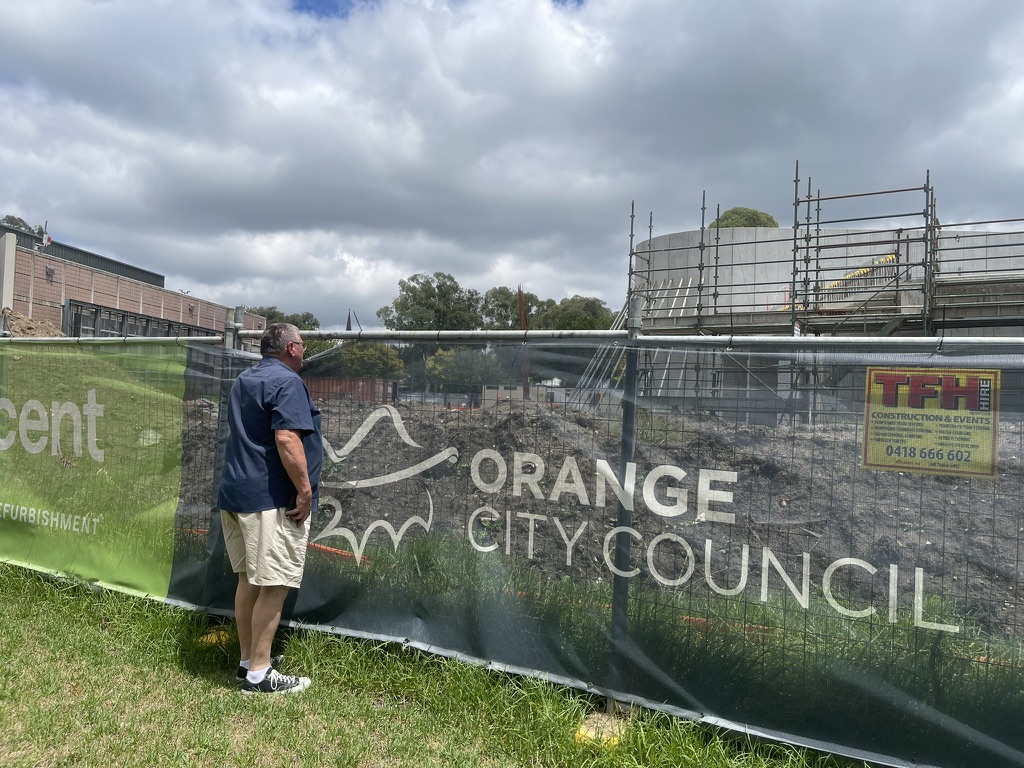
Top featured image: Author of this story, Rod Somerville, documents the progress of the Orange Planetarium. Photo by Merrill Findlay, 16 January, 2025.
Gallery images: Concept drawings of the Planetarium and Regional Conservatorium of Music Complex, courtesy Orange City Council.
Our vision for the planetarium was as an educational and tourist facility to complement and enhance our region’s astronomical heritage. We wanted to foster community understanding of astronomy and the sciences as well as offer a major attraction for visitors to the region. Our concept grew until it included an 11-metre diameter 70 seat planetarium, a multiple telescope observatory, a lecture room, display areas, gift shop and snack bar! It then shrank, morphed, grew and shrank again multiple times until we settled on a final design. For the project to work, however, we needed the support of the people of Orange and surrounding districts. Without their backing, the planetarium was never going to happen. We therefore needed a public relations campaign.
When we started promoting the planetarium concept to local business people, we found that, almost unanimously, they saw the economic and other benefits it would bring. But we also needed the general public behind us, so I began presenting a regular segment on the local radio station and writing a weekly column for the local newspaper. I continued writing those articles for nearly nine years. That’s a total of almost 500 stories! The radio segments were similarly numerous. But our long public relations campaign paid off eventually. It even convinced Orange City Council to back the project.
Council wanted the planetarium to be built on a site that already housed the local library, art gallery, museum and civic theatre. We had no problems with this, as it would create a precinct that would benefit the entire community. And then someone suggested we collaborate with the Orange Regional Conservatorium, which needed a new home. This arrangement had many advantages, so we jumped at the chance. The design we all eventually settled on is unique and I am more than happy with it.
The Prime Minister of Australia, Anthony Albanese, officially turned the first sod on 27 January 2024. More >>, More >> At the time of writing, our Orange Planetarium is little more than a shell on a building site, however. We expect it to be completed in late 2025. When it is fully operational, it will offer science-based activities to thousands of students in more than 100 local and regional schools, and allow the general public to explore the night sky in ways most of them will never have experienced.

Caption
Prime Minister Anthony Albanese speaking on the site of the Orange Planetarium and Conservatorium Complex on 27 January 2024. He was welcomed by Mayor of Orange, Jason Hamling, and joined by the Federal Infrastructure, Transport, Regional Development and Local Government Minister Catherine King, the Federal Member for Calare, Andrew Gee, the State Member for Orange Phil Donato and the NSW MLC Stephen Lawrence. Photo provided by Orange City Council.
This project has been a very long journey for me. In a sense, it began when I was that eight-year-old boy watching the Apollo 11 moon landing at primary school. I was captivated. Even at a very young age, I realised that this was one of the most significant events in human history. I kept every newspaper article of the landing I could get my hands on and filed them away, thinking that someday I would want them. My young self was right. I still had the articles on the 50th anniversary of the Apollo 11 landing, and they have proved to be immensely useful as part of my professional life.

Caption
Front page of Sydney’s Sun tabloid newspaper, 21 July 1969, reporting on the event that inspired a generation of youngsters to become astronomers, space scientists, and engineers. Courtesy of Rod Somerville from his extensive library of newspaper cuttings.
For years after the first moon landing, I read everything I could get my hands on about the world around me. It was pre-internet days, so the only way to get information was through books, magazines and the occasional television show. Every so often, I was able to talk my father into taking me to the old Sydney Planetarium at the Museum of Applied Arts and Sciences (now the Powerhouse), with its a life-sized mock-up of the Apollo Lunar Lander at the front entrance. I loved that museum, as I’m sure a lot of other people did. And then there was my addiction to Lost in Space, Star Trek and other science fiction stories fueling my hunger for all things science and pointing me towards my future.
My interest in all things astronomical ticked along through high school, but eventually it was time for university. As I had planned, I threw myself into as much mathematics and physics as I was able, intending to become an astrophysicist. However, while studying for my undergraduate degree, I did some public science education–astronomy, in particular– and found I liked it, and wanted to do more.
As any university student knows, parents will financially support you for only so long. My parents were very good and never said it out loud, but, as I entered my twenties, I knew I had to start earning a living. So, while I was studying for my Masters degree, I started working casually as a science educator at Sydney Observatory. I didn’t know it at the time, but those first couple of years at Sydney Observatory determined my life’s path. I realised that I wanted to be a science communicator and left university to work full-time at explaining science to the public.

Caption
The historic Sydney Observatory, where the author worked for many years as a science communicator before settling in the IAT town of Orange. Photo by Rod Somerville.
In 1990 the Ayers Rock Resort, near Uluru in Central Australia, advertised for someone to set up an observatory and conduct evening tours of the night sky for their patrons. With the help of a few other people, a close friend and I decided to apply. With a captive audience and crystal-clear and very dark nights, the resort seemed the perfect place to expand my love of the universe. Our application was successful, and we moved to Central Australia.


Captions:
1. The Imalung Lookout Observatory Rod Somerville and his colleague co-established at Ayers Rock Resort, with the famous rock Uluru in the background.
2. The Southern Cross and its Pointers in the Milky Way, by Geoffrey Wyatt. Photos provided by Rob Somerville.
Before our first official session, we figured we’d better familiarise ourselves with the Central Australian sky and do a test run. In Sydney, it had been easy to locate the main constellations because you could only see the brightest stars. This meant identifying the constellations was relatively easy. But when we looked up that first night in the Centre, we could see so many stars, from horizon to horizon, that it was difficult to locate even the Southern Cross, one of the brightest and most recognisable constellations of all! We spent the next few hours identifying four constellations, which we figured was a sufficient number to tell stories around and point out objects within their boundaries.
Two of the constellations I focused on were Crux, the Southern Cross, and Centaurus, which included the two Pointer stars to the Southern Cross. I’d tell my audience that the Pointer furthest from the Cross was Alpha Centauri, the closest star system to our Sun, and reference one of my childhood television favourites. I joked that ‘Dr Smith has a lot to answer for because those space colonists got lost trying to get to the closest star, yet somehow managed to visit dozens of others along the way!’ Some people would get the reference. Most didn’t. But one night, after making my Lost in Space comment, a gentleman thanked me and then told me he once worked as the set designer for the show. We spent the next half hour being total geeks talking all things Lost in Space!
As the year progressed, and my four constellations slowly disappeared below the horizon, I added newfound celestial objects to my repertoire. By the time a year had passed, I was able to point out maybe 70 of the 88 constellations. The only ones missing were those too close to the North Celestial Pole for us to see.
I managed to see objects I’d only ever read about during my time in Central Australia. My favourite pastime was to simply lie on my back, with a clear view away from any lights, and just stare at the incredible night sky. If you have never been to a really dark place in the country, do yourself a favour and go! You’ll see stars visible right down to the horizon. The Milky Way will leap out at you, and, if you have a telescope, you’ll view even the faintest objects in all their glory. You’ll see so many stars it’ll seem impossible to count them all.
When our contract ran out and I had to move back to Sydney Observatory, I was overwhelmed by how light-polluted the sky was. I’d never thought about this while I was growing up, but now that I’d spent years under a gloriously dark night sky, I felt cheated. Because all we had was just a handful of visible stars.
One of the most satisfying aspects of working at Sydney Observatory was getting to meet and interact with people of all ages. Most were friendly and keen to listen and learn. But for me, the children who dragged their parents along because they were super-keen and wanted to know everything they could about space were what made it all worthwhile. In the age before the internet, visiting museums and science centres was often the only way kids could discover new things, and they reminded me a lot of my younger self.
I loved working at Sydney Observatory, but I could also see a niche it didn’t address, and this offered me an opportunity to branch out privately. Sydney’s weather isn’t great for astronomy at times and I wanted to do something astronomical yet weather-independent. A portable planetarium filled the gap in the market perfectly. A permanently located planetarium was out of the question. The cost of construction alone was, at the time, ‘astronomical’. But a portable planetarium meant I could travel to different locations, such as schools, libraries, and shopping centres that had enough space to accommodate the dome. I operated this planetarium with my old business partner from Central Australia for a few years, until I finally left Sydney.
But never let it be said that my business partner and I were lazy! While we were doing all these other things, we were also running the Macquarie University Observatory. This university had a few small domes on campus for students in their astronomy courses, but they wanted to open them to the public. So, they employed us to open the observatory every Friday and Saturday night for a couple of hours.


Captions
1. The indoor planetarium the author and his business partner operated in Sydney. 2. Macquarie University Observatory. Photos by Rod Somerville.
We enjoyed our time there, but it was also clear that we had finally overstretched ourselves. We stuck it out for about a year, but then it was time to move on. I also felt it was time to move out of Sydney again, this time for good. Which brings us back to where I began this story. To Orange and its new planetarium
A planetarium is like a library or museum, where the benefits and ‘profits’ are measured by the educational opportunities, the cultural enrichment, and the economic value it offers a community. It is an indoor facility that creates an immersive experience using technology to project and simulate stars, planets and other celestial objects onto a domed ceiling. The early planetariums just used optical projectors to project star fields. Any additional images were provided by slide and video projectors. But today’s planetariums use digital systems with all the capabilities of modern computers. They can show much more than star fields and astronomical material, making it possible to present shows on a much wider range of subjects.
Our Orange Planetarium and Conservatorium complex will not only offer educational, cultural and leisure opportunities for residents of Orange and our region, it will also stimulate economic growth and business activities by attracting visitors. The revised completion date is now around September 2025. In the not-too-distant future, the Central West will have two more first-class facilities available to the public. I can’t wait for that day to arrive!
More on the Orange Planetarium >>
See Rod Somerville’s book, One Star by Day, Six Thousand by Night: Discovering the Universe (Pegasus, 2020) here >>
You’ll find the Regional Conservatorium and Planetarium behind the City Library in the Cultural Precinct, at 151 Byng St, Orange NSW 2800, behind the City Library.
Page created 15 January 2025. Last updated 20 March 2025
Permalink: https://inlandastrotrail.com/orange-planetarium/
For years after the first moon landing, I read everything I could get my hands on about the world around me. It was pre-internet days, so the only way to get information was through books, magazines and the occasional television show. Every so often, I was able to talk my father into taking me to the old Sydney Planetarium at the Museum of Applied Arts and Sciences (now the Powerhouse), with its a life-sized mock-up of the Apollo Lunar Lander at the front entrance. I loved that museum, as I’m sure a lot of other people did. And then there was my addiction to Lost in Space, Star Trek and other science fiction stories fueling my hunger for all things science and pointing me towards my future.
My interest in all things astronomical ticked along through high school, but eventually it was time for university. As I had planned, I threw myself into as much mathematics and physics as I was able, intending to become an astrophysicist. However, while studying for my undergraduate degree, I did some public science education–astronomy, in particular– and found I liked it, and wanted to do more.
As any university student knows, parents will financially support you for only so long. My parents were very good and never said it out loud, but, as I entered my twenties, I knew I had to start earning a living. So, while I was studying for my Masters degree, I started working casually as a science educator at Sydney Observatory. I didn’t know it at the time, but those first couple of years at Sydney Observatory determined my life’s path. I realised that I wanted to be a science communicator and left university to work full-time at explaining science to the public.
Caption
The historic Sydney Observatory, where the author worked for many years as a science communicator before settling in the IAT town of Orange. Photo by Rod Somerville.
In 1990 the Ayers Rock Resort, near Uluru in Central Australia, advertised for someone to set up an observatory and conduct evening tours of the night sky for their patrons. With the help of a few other people, a close friend and I decided to apply. With a captive audience and crystal-clear and very dark nights, the resort seemed the perfect place to expand my love of the universe. Our application was successful, and we moved to Central Australia.


Captions:
1. The Imalung Lookout Observatory Rod Somerville and his colleague co-established at Ayers Rock Resort, with the famous rock Uluru in the background.
2. The Southern Cross and its Pointers in the Milky Way, by Geoffrey Wyatt. Photos provided by Rob Somerville.
Before our first official session, we figured we’d better familiarise ourselves with the Central Australian sky and do a test run. In Sydney, it had been easy to locate the main constellations because you could only see the brightest stars. This meant identifying the constellations was relatively easy. But when we looked up that first night in the Centre, we could see so many stars, from horizon to horizon, that it was difficult to locate even the Southern Cross, one of the brightest and most recognisable constellations of all! We spent the next few hours identifying four constellations, which we figured was a sufficient number to tell stories around and point out objects within their boundaries.
Two of the constellations I focused on were Crux, the Southern Cross, and Centaurus, which included the two Pointer stars to the Southern Cross. I’d tell my audience that the Pointer furthest from the Cross was Alpha Centauri, the closest star system to our Sun, and reference one of my childhood television favourites. I joked that ‘Dr Smith has a lot to answer for because those space colonists got lost trying to get to the closest star, yet somehow managed to visit dozens of others along the way!’ Some people would get the reference. Most didn’t. But one night, after making my Lost in Space comment, a gentleman thanked me and then told me he once worked as the set designer for the show. We spent the next half hour being total geeks talking all things Lost in Space!
As the year progressed, and my four constellations slowly disappeared below the horizon, I added newfound celestial objects to my repertoire. By the time a year had passed, I was able to point out maybe 70 of the 88 constellations. The only ones missing were those too close to the North Celestial Pole for us to see.
I managed to see objects I’d only ever read about during my time in Central Australia. My favourite pastime was to simply lie on my back, with a clear view away from any lights, and just stare at the incredible night sky. If you have never been to a really dark place in the country, do yourself a favour and go! You’ll see stars visible right down to the horizon. The Milky Way will leap out at you, and, if you have a telescope, you’ll view even the faintest objects in all their glory. You’ll see so many stars it’ll seem impossible to count them all.
When our contract ran out and I had to move back to Sydney Observatory, I was overwhelmed by how light-polluted the sky was. I’d never thought about this while I was growing up, but now that I’d spent years under a gloriously dark night sky, I felt cheated. Because all we had was just a handful of visible stars.
One of the most satisfying aspects of working at Sydney Observatory was getting to meet and interact with people of all ages. Most were friendly and keen to listen and learn. But for me, the children who dragged their parents along because they were super-keen and wanted to know everything they could about space were what made it all worthwhile. In the age before the internet, visiting museums and science centres was often the only way kids could discover new things, and they reminded me a lot of my younger self.
I loved working at Sydney Observatory, but I could also see a niche it didn’t address, and this offered me an opportunity to branch out privately. Sydney’s weather isn’t great for astronomy at times and I wanted to do something astronomical yet weather-independent. A portable planetarium filled the gap in the market perfectly. A permanently located planetarium was out of the question. The cost of construction alone was, at the time, ‘astronomical’. But a portable planetarium meant I could travel to different locations, such as schools, libraries, and shopping centres that had enough space to accommodate the dome. I operated this planetarium with my old business partner from Central Australia for a few years, until I finally left Sydney.
But never let it be said that my business partner and I were lazy! While we were doing all these other things, we were also running the Macquarie University Observatory. This university had a few small domes on campus for students in their astronomy courses, but they wanted to open them to the public. So, they employed us to open the observatory every Friday and Saturday night for a couple of hours.


Captions
1. The indoor planetarium the author and his business partner operated in Sydney. 2. Macquarie University Observatory. Photos by Rod Somerville.
We enjoyed our time there, but it was also clear that we had finally overstretched ourselves. We stuck it out for about a year, but then it was time to move on. I also felt it was time to move out of Sydney again, this time for good. Which brings us back to where I began this story. To Orange and its new planetarium
A planetarium is like a library or museum, where the benefits and ‘profits’ are measured by the educational opportunities, the cultural enrichment, and the economic value it offers a community. It is an indoor facility that creates an immersive experience using technology to project and simulate stars, planets and other celestial objects onto a domed ceiling. The early planetariums just used optical projectors to project star fields. Any additional images were provided by slide and video projectors. But today’s planetariums use digital systems with all the capabilities of modern computers. They can show much more than star fields and astronomical material, making it possible to present shows on a much wider range of subjects.
Our Orange Planetarium and Conservatorium complex will not only offer educational, cultural and leisure opportunities for residents of Orange and our region, it will also stimulate economic growth and business activities by attracting visitors. The revised completion date is now around September 2025. In the not-too-distant future, the Central West will have two more first-class facilities available to the public. I can’t wait for that day to arrive!
More on the Orange Planetarium >>
See Rod Somerville’s new book, One Star by Day, Six Thousand by Night: Discovering the Universe (Pegasus, 2020) here >>
You’ll find the Regional Conservatorium and Planetarium behind the City Library in the Cultural Precinct, at 151 Byng St, Orange NSW 2800, behind the City Library.
Page created 15 January 2025. Last updated 8 May 2025.